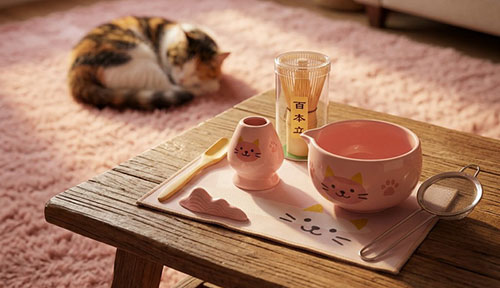

A Complete Guide to Making Matcha
Matcha can be prepared in two main ways: usucha (thin tea) and koicha (thick tea). Usucha is what most people drink day to day, while koicha is reserved for formal tea ceremony. The guide below focuses on usucha, covering the full process and key techniques, and combines both single-pour and three-pour methods in the water-adding step.
I. Tools and Ingredients
Matcha powder: about 1.5–2 g for usucha (roughly 1–2 teaspoons)
Tea bowl: a matcha bowl with a wide opening and thick walls
Chasen: a bamboo whisk; a hyakuhon-jirushi or hachijuppon-jirushi works well
Chashaku: a bamboo scoop
Water: soft water is preferred; hard water affects the taste
Water temperature: 80–85°C (let boiling water cool slightly)
II. The Brewing Process
a. Warm the bowl
Pour hot water into the tea bowl, warm the walls, then discard the water and wipe the bowl dry. This prevents the matcha from sticking to the walls and helps maintain the water temperature.
b. Sift the powder
Sift the matcha through a fine strainer to remove clumps. This is the key to a fine foam—clumped powder is very hard to break up with a chasen.
c. Add water
The total amount of water should be 60–70 ml at about 80–85°C. There are two ways to add it:
Method 1: Single pour (for quick, everyday preparation)
Pour 60–70 ml of hot water slowly down the side of the bowl in one go. This is straightforward and suits high-quality, very fine matcha, as well as people who are already comfortable with the whisking technique.
Method 2: Three pours (more traditional and more forgiving)
3.What the three-pour method does:
Prevents clumping: the first small amount of water wets the powder thoroughly, so dry powder doesn't clump when it hits a larger volume of water.
Lets you adjust thickness gradually: you can fine-tune based on the foam rather than locking in the water amount all at once.
Controls temperature: adding less water each time keeps the bowl temperature from rising too abruptly, reducing the extraction of bitterness.
Produces finer foam: because the powder is evenly dispersed from the start, the foam structure is more stable and finer.
4. Whisking (pointing the tea)
First, use the chasen to gently mix the powder and water at the bottom of the bowl to avoid splashing.
Then relax your wrist and whisk quickly back and forth, fast but without too wide a motion.
After about 15–30 seconds, a fine, even layer of foam will form on the surface.
Finally, lift the chasen slowly from the center of the foam to leave a small peak.
5. Drinking
Usucha can be drunk directly from the bowl, with no sugar or milk needed. For koicha, reduce the water to about 30–40 ml and increase the matcha to 3–4 g; do not whisk it into a foam—just stir slowly into a thick, smooth consistency.
Keep the chasen vertical: try to keep the chasen upright while whisking; don't tilt it and press it against the bottom of the bowl, or the bamboo tines will be damaged.
Use your wrist, not your arm: rely on quick back-and-forth wrist movement while keeping your arm steady—this gives you a finer foam.
Drink it right away: matcha oxidizes and settles easily; drink it soon after whisking, or the foam will collapse and the flavor will deteriorate.
Adjust the amount of powder: add a little more if you like it strong, a little less if you like it light, but keep the ratio of water to powder relatively consistent.
IV. Single Pour vs. Three Pours: How to Choose
Quick rule of thumb: if you're using a fine ceremonial-grade matcha, a single pour is perfectly fine; if your matcha is coarser, you keep failing to get a good foam, or you want a more traditional result, try the three-pour method.
V. Common Problems
No foam?
It could be that the water is too cool, there's too little matcha, the chasen is too old, or you're not whisking fast enough. Try raising the water temperature to about 85°C and speeding up your wrist movement.
Coarse, uneven foam?
This usually means too much water or too wide a whisking motion. Use less water, keep the chasen vertical, and whisk quickly with small movements; you can also switch to the three-pour method.
Bitter taste?
Water that's too hot, too much matcha, or brewing for too long can all cause bitterness. Lower the water temperature, reduce the matcha, and shorten the whisking time.
I. Tools and Ingredients
Matcha powder: about 1.5–2 g for usucha (roughly 1–2 teaspoons)
Tea bowl: a matcha bowl with a wide opening and thick walls
Chasen: a bamboo whisk; a hyakuhon-jirushi or hachijuppon-jirushi works well
Chashaku: a bamboo scoop
Water: soft water is preferred; hard water affects the taste
Water temperature: 80–85°C (let boiling water cool slightly)
II. The Brewing Process
a. Warm the bowl
Pour hot water into the tea bowl, warm the walls, then discard the water and wipe the bowl dry. This prevents the matcha from sticking to the walls and helps maintain the water temperature.
b. Sift the powder
Sift the matcha through a fine strainer to remove clumps. This is the key to a fine foam—clumped powder is very hard to break up with a chasen.
c. Add water
The total amount of water should be 60–70 ml at about 80–85°C. There are two ways to add it:
Method 1: Single pour (for quick, everyday preparation)
Pour 60–70 ml of hot water slowly down the side of the bowl in one go. This is straightforward and suits high-quality, very fine matcha, as well as people who are already comfortable with the whisking technique.
Method 2: Three pours (more traditional and more forgiving)
|
Step |
Water |
Action |
|
First pour |
about 20 ml |
Pour down the side of the bowl and stir gently with the chasen into a smooth, clump-free paste |
|
Second pour |
about 20 ml |
Whisk quickly back and forth to start building foam |
|
Third pour |
about 20–30 ml |
Top up the water and keep whisking quickly until the foam is fine and dense |
3.What the three-pour method does:
Prevents clumping: the first small amount of water wets the powder thoroughly, so dry powder doesn't clump when it hits a larger volume of water.
Lets you adjust thickness gradually: you can fine-tune based on the foam rather than locking in the water amount all at once.
Controls temperature: adding less water each time keeps the bowl temperature from rising too abruptly, reducing the extraction of bitterness.
Produces finer foam: because the powder is evenly dispersed from the start, the foam structure is more stable and finer.
4. Whisking (pointing the tea)
First, use the chasen to gently mix the powder and water at the bottom of the bowl to avoid splashing.
Then relax your wrist and whisk quickly back and forth, fast but without too wide a motion.
After about 15–30 seconds, a fine, even layer of foam will form on the surface.
Finally, lift the chasen slowly from the center of the foam to leave a small peak.
5. Drinking
Usucha can be drunk directly from the bowl, with no sugar or milk needed. For koicha, reduce the water to about 30–40 ml and increase the matcha to 3–4 g; do not whisk it into a foam—just stir slowly into a thick, smooth consistency.
III. Key Techniques
Keep the chasen vertical: try to keep the chasen upright while whisking; don't tilt it and press it against the bottom of the bowl, or the bamboo tines will be damaged.
Use your wrist, not your arm: rely on quick back-and-forth wrist movement while keeping your arm steady—this gives you a finer foam.
Drink it right away: matcha oxidizes and settles easily; drink it soon after whisking, or the foam will collapse and the flavor will deteriorate.
Adjust the amount of powder: add a little more if you like it strong, a little less if you like it light, but keep the ratio of water to powder relatively consistent.
IV. Single Pour vs. Three Pours: How to Choose
|
Comparison |
Single pour |
Three pours |
|
Suitable matcha |
High-quality, very fine matcha |
Coarser or clump-prone matcha |
|
Suitable for |
Experienced users, quick everyday preparation |
Beginners, those after a finer foam |
|
Difficulty |
Low |
Slightly higher |
|
Foam result |
Good, but depends on technique |
More stable and finer |
|
Tradition |
Simplified approach |
Closer to traditional tea ceremony |
Quick rule of thumb: if you're using a fine ceremonial-grade matcha, a single pour is perfectly fine; if your matcha is coarser, you keep failing to get a good foam, or you want a more traditional result, try the three-pour method.
V. Common Problems
No foam?
It could be that the water is too cool, there's too little matcha, the chasen is too old, or you're not whisking fast enough. Try raising the water temperature to about 85°C and speeding up your wrist movement.
Coarse, uneven foam?
This usually means too much water or too wide a whisking motion. Use less water, keep the chasen vertical, and whisk quickly with small movements; you can also switch to the three-pour method.
Bitter taste?
Water that's too hot, too much matcha, or brewing for too long can all cause bitterness. Lower the water temperature, reduce the matcha, and shorten the whisking time.
If you're just drinking matcha day to day, you don't have to stick strictly to tea ceremony form. Master these three things—water temperature, the ratio of powder to water, and whisking technique—and then choose a single pour or three pours based on the quality of your matcha, and you'll get a good cup.